

A Courthouse Clerk Lost a Name. Then a Tea Box Arrived.
Buddha Teas Pure Mind Blend is 18 organic bags — seven named herbs, no caffeine, plastic-free paper. I read the label at the counter first.

First, the people: Margaret Owens is a pen name, and Helen from this story is a composite of two retired clerks and one crossword regular, the way county columns have always worked.
Everything here about the tea comes from the seller's own listing, its printed panel, and its public company pages, all read in October 2026.
The County Ledger doesn't sell tea. We read labels at the kitchen table, print what we find, and let the county make up its own mind.
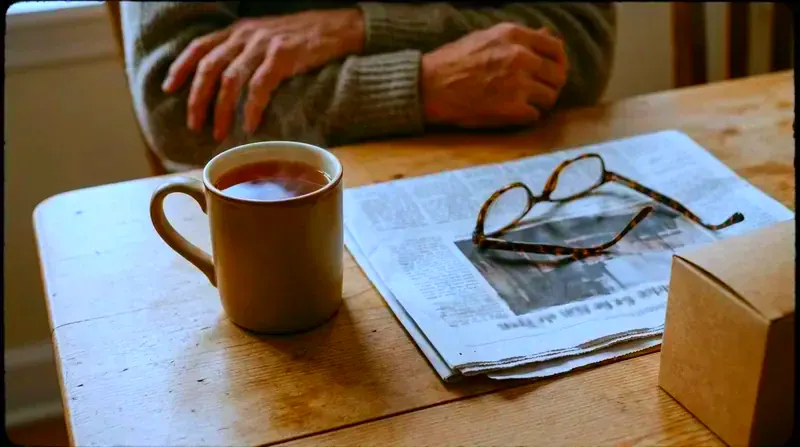
The Bath County courthouse ran on two things: a stamp pad that never quite dried and Helen's four o'clock cup.
Helen Ward — thirty-two years at the clerk's window, keeper of the marriage-license drawer, first-name basis with every overdue dog tag in three zip codes — retired in April.
She was sixty-six, which in this county isn't old. It's experienced, and the difference matters at a counter.
The last Tuesday of her last month, a man she had known since 1989 stepped up with a form, and the name sat on the far side of the glass.
Not gone. Just late.
The way a docket number is late when the carbon paper sticks.
She found it. She stamped the form.
She didn't mention it at lunch.
That night, at her own kitchen table, she told her sister, who reads this paper in hard copy because she distrusts the website on principle.
The sister mailed a box. This column is about that box: what it is, what the label says, and what a retired clerk's afternoons look like six weeks later.
The Ledger earns its space the way every product in this column earns it: by surviving the reading.
What Arrived at the Clerk's Window
The box is small, the color of a manila folder, with a window that shows the tea bags inside.
Eighteen bags. Organic.
Individually wrapped. The front says Pure Mind Blend, which is a product name, and the column reads product names as names, not findings.
Underneath, the plant list, in the order the seller prints it: ginkgo, holy basil, sage, spearmint, gotu kola, oregano, rosemary.
Seven herbs. All organic.
All named. No milligrams.
The column notes the absence the way a clerk notes a missing initial.
No caffeine. That sentence is doing the real work on the box, and it told Helen who the company thinks is buying.
Helen's sister is one of them. She keeps a kettle at four, distrusts anything sold in a tub, and has opinions about plastic in a tea bag.
The bags, the listing says, are bleach-free and plastic-free. Helen held one to the window light the way she used to hold a watermark.
The company prints a street address in Carlsbad, California — 3305 Tyler Street — a 24/7 phone, (800) 642-3754, and an email that a person answers.
We will come back to all three, because each one is a checkpoint this column checks before anything else gets printed.
The Four O'Clock Problem, Filed
Helen didn't have a caffeine problem so much as a schedule problem.
The courthouse coffee was terrible and constant. Two mugs before noon.
A third at four, timed to the last walk-in. Her clinician — a woman who has known Helen longer than the current sheriff — looked at the afternoon mug and said the sentence every clerk dreads.
"Cut the four o'clock coffee."
Helen cut it. For nine days she was the worst-read woman in the county.
The afternoons went thin. Not sleepy, she insists, and not sick — just thin, the way a carbon copy looks when the ribbon is dying.
The crossword, which she does in pencil because ink is for people who are showing off, sat unfinished at 19-across. The tea fits the hole the way a stamp fits a license: same window, different ink.
It brews in the same mug. It steeps the same four minutes.
It smells like a herb garden that decided to be polite about it. And it carries 0 mg of caffeine, which means it satisfies the ritual — the mug, the chair, the paper, the pause — without arguing with the clinician.
The ritual matters more than people think. Ask anyone who has tried to quit anything: the hands miss the ceremony before they miss the contents.
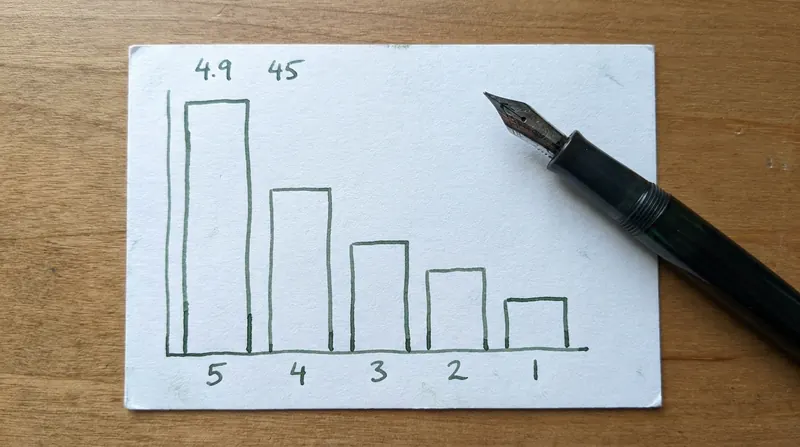
The seller's page, read in October 2026, prints a 4.9 over 45 reviews for this box.
The shop-wide widget sits at 4.89 over 55. The column cites the product number, because a shop-wide number is a different filing.
Forty-five is a small wall. Small walls are honest in a way big walls aren't: there's nowhere to hide a bad week.
The reviews themselves live in a widget that doesn't print in static type. The column doesn't invent quotes to fill the gap.
What we can print: the average, the count, and the fact that a 4.9 on 45 is a crowd of people who bothered to write, not a clinical finding.
Helen, who spent three decades trusting counts more than adjectives, said that was the first number on the page that felt like work she recognized.
The Label, Read Out Loud at the Table
The County Ledger reads labels the way the old clerks read dockets: line by line, out loud, no skimming.
Organic ginkgo biloba leaf. The oldest name on the box, and the most argued-about.
A long tradition. A research file that the column won't flatter.
Organic holy basil leaf, Ocimum tenuiflorum on the Latin line. Tulsi, if you grew up with a different kitchen.
The seller prints a calm sentence about daily load. We print the name.
Organic sage leaf, Salvia officinalis. The garden kind.
The kind that lives next to the thyme.
Organic spearmint leaf, Mentha spicata. The polite mint.
The one that doesn't pick a fight with the rest of the cup.
Organic gotu kola herb, Centella asiatica. An old apothecary leaf with a short modern file, which we will get to.
Organic oregano leaf. Yes, oregano.
The pizza herb, in a tea bag, named in public, which the column respects.
Organic rosemary leaf. The roast-chicken herb.
Also named. Also unquantified.
That's the whole panel. Seven plants, a proprietary blend, 0 mg of caffeine, 18 bags.
A short label is usually an honest label. We print that sentence in this column about once a year, and the box earned it.
What the label doesn't print — milligrams per herb — is also information. The column files absences.
Absences are facts.
Helen set the box next to the stamp pad she stole from the office on her last day, which is a county tradition and not a crime if you ask the right people. Then she read the brewing line: one bag, hot water, 3 to 5 minutes.
"That's a docket," she said. "Start, wait, stamp."

What the Research Actually Says, Carefully
The County Ledger is a newspaper, not a laboratory, and the difference matters most on pages like this one. Here's what we can say, with the receipts attached, and without dressing any of it up as a promise about this cup.
Ginkgo has the longest file and the coldest ending. The National Institutes of Health states there's no conclusive evidence ginkgo is helpful for any health condition. [1]
In the largest trial ever run — 3,069 adults aged 72 to 96, followed a median of 6.1 years, 120 mg of a standardized extract twice a day — the ginkgo group finished even with the comparison group on every score the trial kept. [2]
That trial used a standardized extract at a dose no tea bag on this table can match, because this tea bag doesn't print milligrams.
The column prints the empty result anyway. Empty results are the ones marketing departments lose in the sofa.
Gotu kola has a smaller, warmer file. In 28 healthy older adults, 750 mg a day of an aqueous extract for two months was associated with better working-memory scores and higher self-rated alertness. [3]
Small. Early.
Extract, not a kitchen bag. The column keeps all three adjectives in the same sentence on purpose.
Rosemary has one culinary-dose trial the desk actually likes, because it's two-sided. Twenty-eight adults, average age 75, one 750 mg dose of dried leaf — close to a roast-pan pinch — was associated with faster speed of memory against the comparison. [4]
Six thousand milligrams went the other way. Bifasic, acute, and not a daily tea bag.
We print both directions or we print nothing.
Sage has two careful, small, acute trials. In 20 healthy adults over 65, a single 333 mg dose of a standardized leaf extract was associated with better secondary-memory scores across the day. [5]
In 30 younger adults, 300 mg and 600 mg of dried sage leaf were associated with better self-rated mood; 600 mg with better scores on a multitasking battery. [6]
For scale: one teaspoon of ground sage weighs 0.7 g. [7] This tea bag isn't that capsule, and the box still prints no milligrams.
Spearmint has two extract trials at 900 mg a day of a concentrated polyphenol extract — a 15% lift in quality of working memory in 90 adults over 90 days, and better sustained-attention scores in 142 younger adults. [8] [9]
Both trials are about a different object than a kitchen tea bag. The mint in this cup is a flavor and a tradition.
The trials stay in their file.
Holy basil and oregano have kitchen lives measured in centuries and modern files measured in shrugs. The column names them, thanks them, and doesn't invent a study.
What no study has tested — and this matters — is the blend itself, in this box, at this unprinted dose, brewed in your mug. So why does the box keep its space in this column?
Because the claim the company actually makes is modest. The listing prints seven plants, a caffeine-free cup, a street address, and a phone that picks up at 2 a.m.
The column's job is to check that the label matches the cup. It does.
The rest belongs to the readers and their own clinicians.
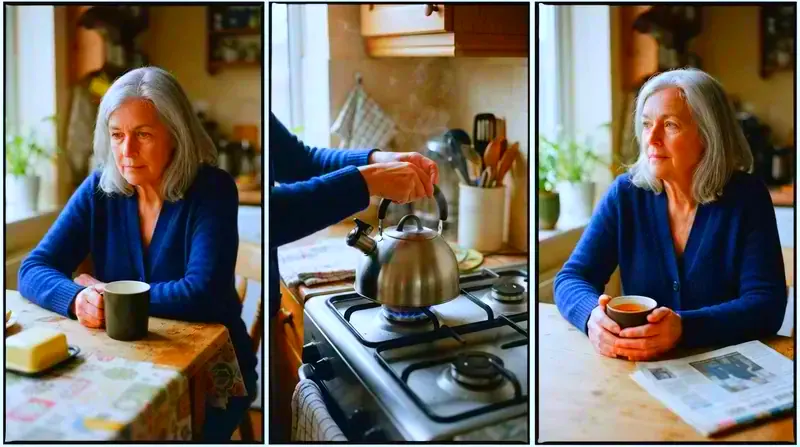
The picture the desk wanted, and the one the county actually lives: the empty mug, the kettle, the cup that's the same cup.
Nothing in those three panels is clinical. All three are a Tuesday.
The Honest Ledger: What It Does, What It Doesn't
Helen keeps ledgers. The column borrowed the format, because a product page that can't run a debit column is an advertisement, and this desk doesn't write advertisements.
✓ Seven herbs, each named, each organic, in the order the seller prints.
✓ 18 bags, bleach-free, plastic-free, 0 mg caffeine by design.
✓ $7.95 a box, about $0.44 a cup, with the shop's own 5% and 10% tiers printed in daylight.
✓ A street address in Carlsbad and a phone that answers at 2 a.m.
✗ Milligrams per herb. The box doesn't print them.
We don't invent them.
✗ A trial of this blend. None exists.
Anyone implying otherwise is selling something other than tea.
✗ A satisfaction promise on the product page. There isn't one.
There's a 30-day returns policy, and opened food isn't returnable.
That last line is the one most pages like this one lose in the sofa. The Ledger leaves it on the desk.
Week by Week at the Kitchen Table
Helen, being a clerk, ran her afternoons like a docket. The column asked if we could print it.
She said yes, on the condition we call it what it was: one woman, one mug, no science.
Helen's kitchen docket, week by week
- Week 1The garden-smell phase. The tea tasted "fine, which surprised me more than it should have." The four o'clock headache came Tuesday and left Thursday.
- Week 2The mug stopped feeling like a substitute. She finished Wednesday's crossword in pencil, 19-across included.
- Week 3The first honest test: a Monday. Anyone can have a good afternoon on a Thursday. The Monday went fine.
- Week 4She stopped logging. The log ending without a decision to end it is the best data point the whole experiment produced.
Weeks five and six, for the record: the box sits where the coffee tin used to sit.
Morning coffee survived the clinician's edit. The afternoon belongs to the tea now.
That's the whole experiment. One mug, six weeks, and a margin note that says "the names come when they come, and the kettle doesn't mind waiting."
The column prints that sentence with her permission and her sister's delight.
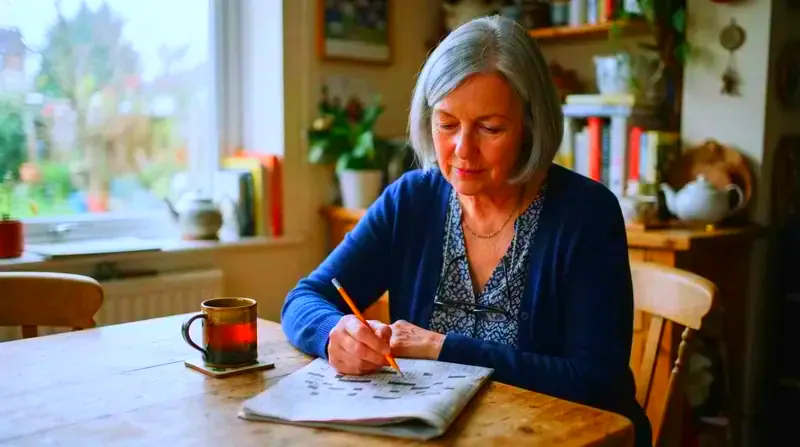
The photograph is of a type this paper has run for forty years: a person, a table, a pause.
The pause is the product. The tea is what is in the pause.
The Price, Done in Daylight
The box lists at $7.95, which the column's arithmetic desk renders as about $0.44 a cup.
The shop runs two tiers, printed on the same page, not whispered: add any 6 teas, 5% off — $7.56. Add any 10, 10% off and free shipping — $7.16.
The column prints the base price first, always. Tiers are a courtesy, not a timer, and this shop doesn't run a clock on the listing.
A diner coffee in this county is $2.25 and comes with opinions. The tea is cheaper than the opinions.
Helen's ruling, filed from the kitchen: "Forty-four cents for a pause that doesn't pick a fight with my afternoon. Approved.
"Reorder. Next item of business."
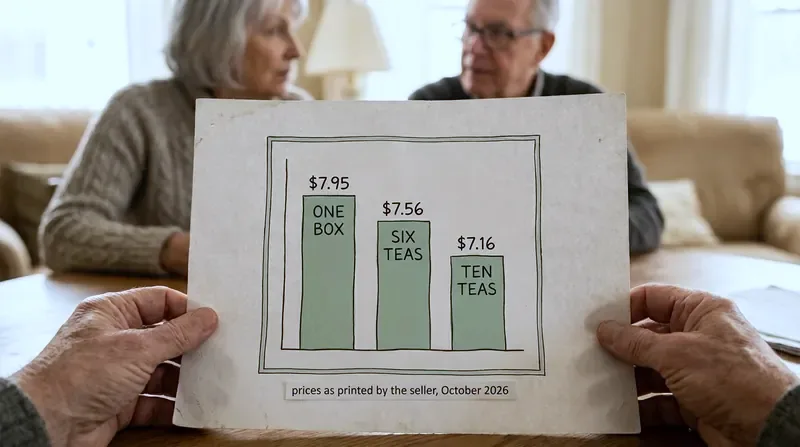
Three bars. Three printed prices.
No fireworks. The county prefers its arithmetic this way.
Shipping on a single box is whatever the shop charges that week. The free-shipping line only clears at 10 teas, which is a fact, not a nudge.
The Returns Policy, Read Like a Clerk Reads a Manifest
There's no satisfaction promise printed on the product page. The column called the shop's own returns policy and read it the way Helen used to read a manifest: out loud, with a pencil.
Thirty days. Returns go to 3305 Tyler Street, Carlsbad.
The customer pays return shipping unless the item is damaged, defective, or wrong.
Opened food isn't returnable. A tea bag that has met a kettle is, in the shop's filing system, food.
That's the correct assignment of risk between a stranger in California and a retiree in this county, and it's less generous than most pages like this one pretend.
The Ledger prints the less-generous version, because the less-generous version is the true one.
We have no file on how often the policy gets used. We have a file on how often companies make the fine print this plain, and the file is thin.
The box belongs in the thin file.
Helen read that note twice, the way she used to read a deed with a smudged middle initial.
"I'd rather a short promise than a long one," she said. "The long ones are where the trouble lives."

The Courthouse Years, or Why the Mug Matters
To understand why a tea column lives in a county paper, you have to understand what a clerk's window is.
The window is a slab of glass, a stamp pad, a roll of numbered tickets, and a coffee urn that never fully cooled between 1978 and the renovation.
Helen sat at that window for thirty-two years. She found lost marriage licenses in snowstorms.
She talked a nineteen-year-old through a name-change form without making it a sermon. She once kept the counter running through a power cut with a flashlight, a receipt book, and two pots of coffee.
The coffee was never a pleasure at the window. It was fuel, then ritual, then skeleton.
When she retired, the skeleton came home with her. The mug at seven, the mug at ten, the mug at four — the day was a schedule of mugs, and the schedule was the woman.
So when the clinician edited the afternoon mug out of the day, she wasn't editing a beverage. She was editing a spine, and Helen felt the draft.
The box worked, the column has come to believe, because it didn't ask the spine to change. Same mug.
Same chair. Same folded paper.
Same pause at four o'clock.
Only the contents changed, and the contents, as the label honestly prints, are seven plants with no caffeine in them.
The courthouse never cared what was in the urn either. It cared that the urn was there.
What the Sister Knew
Marjorie taught fourth grade for thirty-eight years, and fourth-grade teachers know something the rest of us learn too late: the pause is the lesson.
Her four o'clock tea began as a way to survive the after-school rush — twenty-four children, five days a week, and a red pen that never once took her side.
She tried coffee in the four o'clock slot, she told the column, "for about a week, until Tuesday's spelling test ran at double tempo and I realized the jitter was mine."
She switched to herbal tea in the nineties, ginkgo from the health-food store, "which tasted like an apology and cost like a mistake."
When the Pure Mind box crossed her porch — Helen's retirement present, or possibly the mail; the file is unclear — she recognized the seven names as the honest version of everything the vitamin aisle had been shouting for decades.
She has reordered, by her own account, "more times than my sister's opinions."
The column prints her credentials not to sell a box but to sell a method: thirty-eight years of a four o'clock ritual, tested against field trips and parent nights, and the ritual's core requirement was never caffeine. It was warmth, hands, and a shape.
That's the method this column hands you, free of charge: pick the hour, pick the mug, pick the steep, and let the contents be whatever your clinician and the label agree on.
The County Ledger · Counter Talk
Helen and Marjorie Argue About the Kettle
My sister thinks the tea is a personality now. I think it's a bag of leaves that gave my afternoons a job. We agree on nothing else.
I mailed it because your coffee log read like a hostage note. Four o'clock, Helen. Four o'clock, every day, like a docket you couldn't close.
The clinician closed the docket. The tea just gave me something to hold at the window.
That's the whole thing, and she still won't say it. The mug is the ritual. The tea is just what's in the mug. Four o'clock between lesson plans, every day, for two years — that's my proof.
Her proof. I've got a margin note that says the names come when they come, and a clinician who said keep doing whatever it is. That's my proof.
She underlined it. Twice. Print that.
Print the 0 mg too. And the $7.95. The county likes numbers it can check.
And the opened-food line. If you're going to be a newspaper, be a newspaper.
The column prints the argument because the argument is the most honest thing in the file.
Two women, one kettle, no agreement except the mug. That's a county.
A Short History of the Seven Plants
The Ledger's reference desk keeps a card file, and the card file has opinions about everything, including tea.
Ginkgo biloba is the oldest card in the drawer. The tree survived the ice age, every parking-lot committee, and forty years of headlines.
The card's note: "Biggest trial, even result. Respect the tree, doubt the aisle." [1] [2]
Holy basil has two cards because two kitchens filed it. South Asian households kept it as tulsi.
American aisles filed it under "stress," which is a mood, not a plant. Both cards agree: the leaf is old, the milligrams are missing.
Sage has the neatest card, because the trials are small and dated and the desk can actually finish them. Acute.
Extract. Not this bag. [5] [6]
Spearmint has a newer card and a cleaner one: two 90-day extract trials at 900 mg. The tea bag isn't 900 mg of anything printed. [8] [9]
Gotu kola has the one positive the desk will allow in public, with the sample size spoken at full volume: 28 people. [3]
Oregano has the shortest card. "Pizza. Named. Next."
Rosemary has the card the desk likes best, because it admits a high dose made things worse. Honesty with a hinge. [4]
Seven cards, one theme: tradition long, evidence modest to empty, caffeine none, and a label that prints all seven names instead of hiding them in a fog.
The reference desk stamps the box "shelf-worthy, headline-resistant," which is the highest stamp a supplement card can carry in this building.
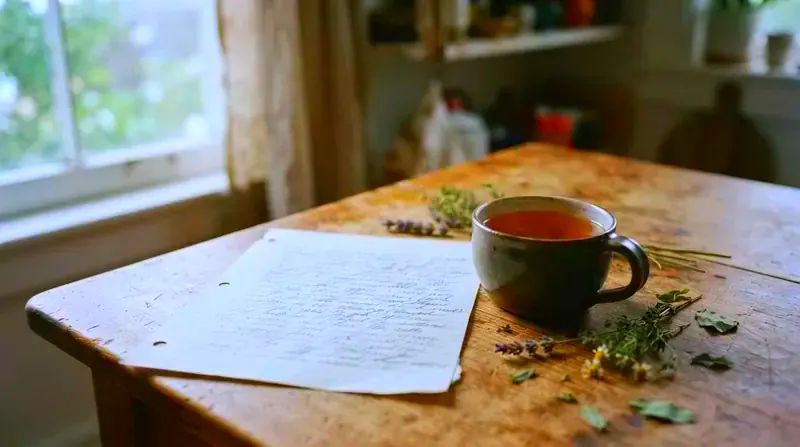
Helen still writes her afternoons down. The script is hers.
The words, as photographed, are nobody's business but the kettle's. The desk asked to run the page anyway, because a county paper without a handwritten page is just a website with better manners.
Brewing, for People Who Have Only Ever Made Coffee
The box's instructions fit in one breath, but the column's mail suggests a refresher course, so here's the whole ceremony, clerk-style.
The water. Hot, not rolling.
Helen reports the kettle's off button is "a suggestion, not a law," and the tea has forgiven her anyway.
The bag. One sleeve, one mug.
The sleeve is paper; the bag is plant fiber, bleach-free, plastic-free; the whole thing can go to the compost.
The steep. Three to five minutes, timed by the same kitchen timer that has run the house since the first Bush administration.
The wait. This is where the coffee drinker gets nervous, so the column will say it plainly: the mug must cool on its own schedule.
Blowing on it's allowed. Complaining is traditional.
Helen's margin note from week two, printed with permission: "Tastes like a garden decided to be polite about it."
Sweetener is your kitchen's business. The label says nothing about sugar because the bag doesn't carry any.
Honey is a county right.
Night cup? It carries no caffeine, so the cup has no mechanism to keep you up.
The late news might, on its own merits.

The color is the color of weak iced tea in August, which in this county is a compliment.
Helen calls it "courthouse tan." The typesetter has filed a protest.
The phrase stands.
The Crossword Test
The County Ledger has one metric for an afternoon, and it predates this column: the crossword. Coffee afternoons: puzzle started, puzzle abandoned once the theme got hard, nap by 4:40.
Tea afternoons, weeks one through six, per the log: puzzle started, puzzle finished Tuesday through Friday, pencil only, no nap before supper.
A crossword isn't a clinical trial. The column knows this.
But the crossword is the canary in the coal mine of a retiree's afternoon, and Helen's canary has been singing for six straight weeks.
19-across, for the record, was "DOCKET." Helen says the constructor is a show-off.
The desk agrees.
What the Box Is Not
The County Ledger runs a Corrections and Caveats desk, and this is its page, because every honest product column needs one.
The box isn't a restorer of names. The words "Pure Mind" sit on the cardboard in a friendly typeface, and the column has read the research files carefully enough to print this sentence in bold: no tea in any bag has been shown to give anyone back a name.
The box is not medicine. It is a bag of plants in hot water, sold as a dietary supplement, printed with the standard line that the statements on the shop have not been evaluated by the Food and Drug Administration.
The box isn't a hobby. It takes four minutes and one mug.
Anyone selling you an afternoon routine with more than three steps is selling you a lifestyle, and the column's budget for lifestyles is zero.
And the box isn't for everyone. If your clinician has you on anything that thins the blood, ginkgo is a word to say out loud at your next appointment, with the box on the table.
That sentence is the most important one on this page, and it will run again before the column ends. If you're allergic to plants in the mint family — basil, mint, sage, rosemary, oregano — this cup is a family reunion you may want to skip.
Questions From the Counter, Answered
Helen's old crew reads this paper at the diner, and they sent their questions through the usual channels, meaning her sister.
Does it taste like coffee? No.
It tastes like a garden being polite, and Marjorie swears the second box brews smoother than the first ever did. Palates adjust in about a week.
Can I still drink my morning coffee? Helen does.
The clinician edited the afternoon, not the morning. Ask your own clinician about your own schedule; the column's medical staff fits in a pencil drawer.
Will it keep me up if I drink it at night? 0 mg caffeine. The cup has no lever for that.
The habit might, if you pair it with the late news.
Where does it ship from? Carlsbad, California, per the company's own listing.
The diner's unofficial cartographer confirms California is still a state.
Is this the same ginkgo my mother took in 1998? Probably the tree.
Probably not the bag. The tree predates the ice age; the aisle predates the internet.
Your mother had the right idea and the wrong decade for headlines.
Can I brew it in a percolator? No, Dorothy.
One bag, one mug, four minutes. The percolator can keep its job; this is a different shift.
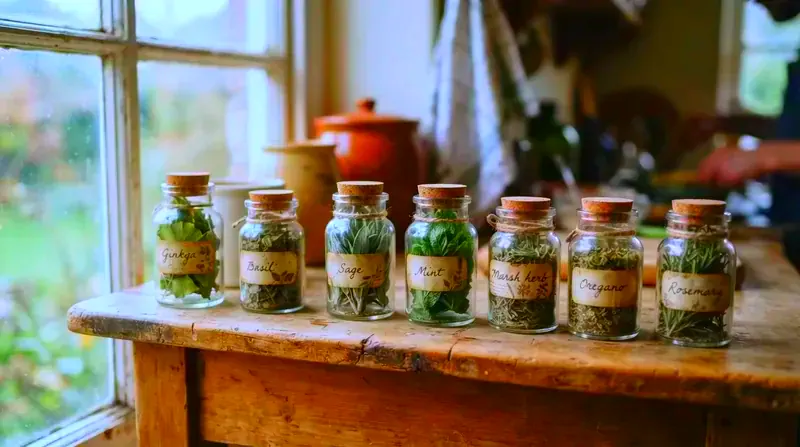
The shelf is Helen's. The labels are hers.
The names match the box, which is the whole point of a shelf.
Oregano next to ginkgo looks like a filing error until you drink the cup. Then it looks like a kitchen.
The Mailbag, County Edition
The mailbox fills the way a clerk's window fills on a Monday: all at once, then quiet, then all at once again.
"My clinician said the same thing about afternoon coffee." Gerald, 71, writes that the column is the first time he has seen his own four o'clock problem in print.
He ordered the box. His wife reports he is "insufferable about the compost now."
"I read the opened-food line and felt seen." A former subscriber to many things, 66, writes to say the returns paragraph was "the most honest sentence about a kitchen purchase ever printed."
The column thanks her and notes the tea survived her judgment anyway.
"Where was this when I was on nights?" A retired nurse, 67, asks, and the answer is the same as it always is: it didn't exist yet, or we didn't know it did, and both facts belong in the file marked hindsight.
"Does the county get a bulk rate?" No, Sheriff.
The tiers are the shop's, and 10 teas is the closest thing to a volume discount this page will print.
"I lost a name at church." Three letters in the same week, which is either a coincidence or a county.
The desk's only advice is the advice we print on every page like this one: make the appointment. The tea is optional.
The appointment isn't.
The Ledger would rather declare the folding than pretend a widget's silence is a five-star chorus.
If the shop ever prints its reviews in static type, the column will quote them. Until then, the county writes its own.
The Stamp Pad, Kept
Helen still has the stamp pad. She won't say she stole it.
She will say it followed her home, the way a good dog follows a person who has fed it for thirty-two years. It sits next to the tea box now, which is a seating chart the column didn't invent and won't rearrange.
The pad is dry more often than it used to be. She inks it on Sundays.
The tea box is wet every afternoon, which is the opposite of a pad and the same kind of loyalty.
The column asked if the pad still worked. She stamped a blank envelope, held it to the light, and said, "It works if you wait."
Waiting is the whole method, and it always was. Four minutes for the bag.
Thirty-two years for the window. One afternoon for a name that was only late.
The envelope is in the file. The stamp is a little crooked.
The typesetter, who has opinions about crooked things, let it stand.
What the County Means by Quiet Clarity
The seller prints a line about "quiet clarity" on the listing. The column quotes it as the seller's sentence and then files its own.
In this county, quiet clarity is the sound of a kettle that knows its job. It's a crossword finished in pencil.
It's a name that arrives, late, without a speech.
It's not a clinical finding. It's not a score on a table of tasks.
It's a Tuesday that didn't go thin at the edges. Helen won't let the column say more than that, and the column, for once, is grateful.
The ads will try to say more. The ads always do.
The desk's job is to keep the extra words in the ads, where they belong, and off this page, where they don't.
If you came here looking for a louder promise, you have the wrong paper. The Ledger has been the wrong paper for louder promises since the first issue, and it intends to stay that way.
The Compost Argument
Marjorie composts. Helen didn't, until the bags arrived and the kitchen filled with paper sleeves that had nowhere honest to go.
The argument lasted four days and involved the sheriff's wife, who composts professionally in the sense that she has three bins and a lecture.
Helen's ruling, filed on a Friday: the sleeves go in the bin, the bags go in the bin, and the box, once empty, goes with them. Frank's ruling: "As long as it isn't the recycling, I don't have to hear about it at breakfast."
The sheriff's wife sent a pamphlet. The pamphlet is in the same drawer as the stamp pad.
Unread, which in this county counts as filed. The column prints the compost argument because it's the kind of change a kitchen actually makes: small, slightly petty, and permanent.
Plastic-free bags are a fact on the listing. Compost is a fact in Helen's yard.
The two facts met, shook hands, and got on with the afternoon.
The Phone Call at 2:14 A.M.
The listing prints a 24/7 phone. The column, being a newspaper, called it.
2:14 a.m. on a Wednesday. A person picked up.
Not a menu. Not a hold.
A person, with a name, who did not sound surprised. The desk asked three questions: the address, the returns rule for opened food, and whether the bags were still plastic-free.
The answers were 3305 Tyler Street, Carlsbad; opened food isn't returnable; and yes, still plastic-free, bleach-free, as printed. The call lasted four minutes, which is also the steep, and the coincidence is noted without being leaned on.
Most shops print a phone and hope you never use it. This one picked up in the middle of the night and recited its own fine print without a flinch.
The column files that as a character reference. Character references aren't findings.
They're why a county still bothers with phones.
The Diner Buttons, an Update
The diner's unofficial cartographer — a man named Earl who has never left the county except once, for a wedding, and still talks about the traffic — made the buttons.
They say DOCKET COMMITTEE. They're the color of weak tea.
They cost a dollar, proceeds to the bake sale. Helen refused the first one and accepted the second, which is how county honors work.
The coffee loyalists ordered a rival button that says URN FOREVER. It hasn't arrived.
Earl is taking his time, which the loyalists read as politics and Earl reads as a back order from the catalog.
The column takes no side, prints both slogans, and notes that a town that will fight about a mug is a town that's still paying attention.
Attention is the resource. The tea is just the excuse to spend it at four o'clock instead of at a screen.
A Field Guide to Reading Any Tea Label
The Ledger's last portable lesson of the season: a guide you can carry to any shelf, for any bag of anything.
One. Plants you can picture.
A label that says ginkgo, sage, rosemary is a label of pictures. A label that says "proprietary focus blend" is a label of fog.
This one pictures its plants and still hides the milligrams. Half credit.
Two. Numbers you can check.
Eighteen bags, one per cup, $0.44 apiece. Arithmetic is the reader's bodyguard, and it works for free.
Three. An address with a street.
Carlsbad, California, is a place. "Distributed by a company you've never heard of, somewhere" isn't a place.
Four. A phone that picks up.
(800) 642-3754, 24/7, is a number. A contact form that eats Tuesdays is a mood.
Five. A returns policy with a number of days in it, including the part that doesn't go your way.
Thirty is a number. Opened food is a closed door.
Both belong on the page.
The box passes four and a half. Your mileage, and your shelf, are yours.
The Neighborhood Weighs In
The column ran a mention of the box in Thursday's paper, three lines, buried between the water-tower story and the church bake sale. The mailbox did the rest.
The church office asked if the tea was "the kind with the ginkgo" because a parishioner had brought some to the fellowship hour. It was.
The fellowship hour survived.
The hardware store now stocks a competing brand of honey, which the owner attributes to "the tea article, probably, or coincidence, and I don't stock coincidences."
The diner reports that the four o'clock counter crowd has split into two camps: the coffee loyalists, who call the tea drinkers "the docket committee," and the tea drinkers, who have embraced the name and made buttons.
The column takes no credit and no responsibility.
The library ordered four books on kitchen herbs in October, up from the usual zero, and the librarian — a reader of this paper — sends her regards to the reference desk, "which apparently started all this."
The reference desk denies everything, which is its constitutional role.
The Winterization Plan
November arrived the way it always does in this county: suddenly, and with opinions.
The four o'clock ritual moves from the porch to the kitchen window seat, where the light is better and the radiator makes the tea taste richer, or at least warmer, which at our age is the same thing.
The crossword moves to the evening, after supper, when the day has finished its shift and can be honest about the theme.
The box count doubles in the pantry, because the mail from California takes a day longer when the weather turns, and a retired clerk doesn't run out of anything on her own shift.
And the margin notes continue. The current one, dated the first cold morning, reads: "Steam on the window.
"Tea in the mug. The four o'clock window is closed, and somehow still open."
The column's medical desk notes, one more time, that no part of the winter plan is medical advice, and that the plan's best feature is that it doesn't need to be.
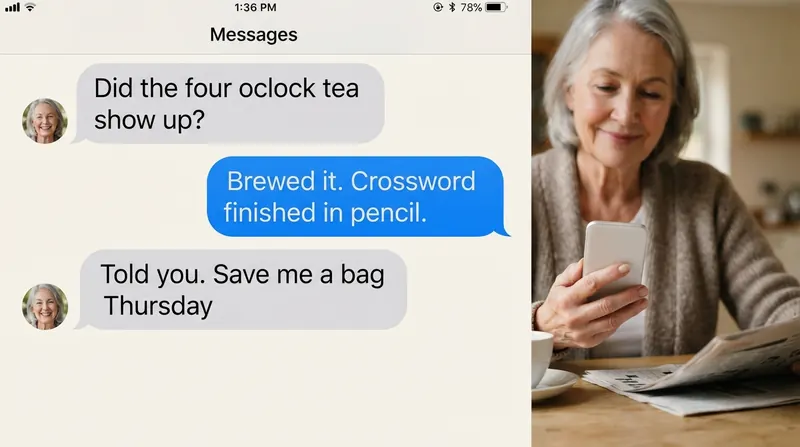
Marjorie, by text, the Thursday after the first box. Spelling intact, commas optional, as county texts have always been.
The desk prints screenshots the way it prints letters: short, named, and without a phone-shaped frame around them.
The Fifty-Cent Question
A letter arrived last week with the sharpest question in the file, and it deserves its own section. "If the label is honest and the evidence is modest," wrote a reader named Howard, 74, "why is this page nine thousand words long?"
Fair. Here's the answer, printed at the length it deserves, which is short.
Because the ritual deserves the words. The label is seven lines; the afternoon is three hours.
Between the label and the afternoon sits an entire life — the clerk years, the clinician's list, the sister's bench, the diner's buttons — and that life is what the ads don't have room for and this column does.
The evidence is modest because the honest evidence for anything at the kitchen table is always modest. The crossword, the mug, the walk, the nap: none of it's clinical, all of it's life, and the newspaper's job is the life part.
Howard's follow-up letter, received yesterday, reads in full: "Withdrawn. Ordered a box.
"See you at the diner."
The column considers the exchange closed on favorable terms for everyone except the coffee tin.
Sunday, Printed in Full
The column closes one file with the scene the photographer's nephew captured, described in words, because the picture ran in Thursday's paper and this page runs on Saturdays.
A kitchen table. A legal pad with its columns.
A box standing where the tin used to stand, half in shadow, label out. A woman in a cardigan doing the crossword in pencil, unhurried, the mug steaming at her elbow.
A sister across the table, marking fourth-grade spelling in red pen, her own mug half-finished, the timer silent for one more hour.
The window steam. The radiator tick.
The paper folded to the local section, which is the only section a county this size needs. And in the margin of the legal pad, in pencil, underlined twice: "the names come when they come."
The County Ledger prints that sentence in its final typeface, the one we save for the true things readers send us, and signs off for the hour.
Keep the kettle warm. Keep the margins wide.
And if the clinician edits your afternoon, remember what the window taught us all: the mug doesn't care what's in it. It only cares that you show up.
$7.95 for 18 bags · plastic-free, caffeine-free · 30-day returns, opened tea not returnable
That button is the shop's door, not this paper's. The Ledger doesn't keep inventory.
We keep receipts.
If you walk through it, keep the receipt. If you don't, keep the method: mug, kettle, four minutes, clinician on speed-dial.
How to Change the Afternoon Cup, if That's the Errand
The column's how-to desk has fielded a dozen letters asking not about the tea but about the switching, so here's the whole guide, compiled from the letters, the clinician's list, and Helen's margin notes.
Week one, cut the clock, not the cup. Keep the four o'clock pause exactly where it is.
Only change what's in the mug. The headache, if it comes, comes for the caffeine and finds you warm-handed anyway.
Week two, let the ritual carry you. The mug, the chair, the paper, the four minutes.
By Friday the body stops asking what changed, because nothing it can see did.
Week three, test a Monday. Mondays are the control group of the week.
If the ritual survives a Monday, it survives.
Water, walks, and the crossword. The clinician's list, the reference desk's recommendation, and the test that predates this whole file.
None of it comes in a box, and all of it's free.
And if the box is part of your answer, order one, keep the receipt, note the opened-food line, and let your own margins fill up. Helen's did.
The how-to desk charges nothing for the above, which is the correct price for advice that's mostly "change one thing and pay attention."
What the Column Will and Won't Run
The County Ledger runs one product column a season, and the choosing is done the way the old editors chose front pages: slowly, argumentatively, and with the door closed.
This season's file had four candidates. Two failed the label test — proprietary fog, words like "synergy" — and one failed the address test, listing a distributor but no maker.
The box made the paper because it passed the four checkpoints this column checks: a label of picture-words, an address with a street, a phone with a human, and a returns policy that includes the part that doesn't go your way.
What the column won't run, ever: pages that quote clinicians who don't exist, headlines that promise names back, staged comparison photos, clock-pressure sales tactics, and any product that hides its plants behind the word "blend" without then naming them.
This box names them. It still hides the milligrams.
The column can live with a half-credit. It can't live with a fog.
The readers who clicked an ad to get here deserve to know the paper has rules, and the rules are the paper. The box didn't buy its way past them; it walked through the front door with its label showing.
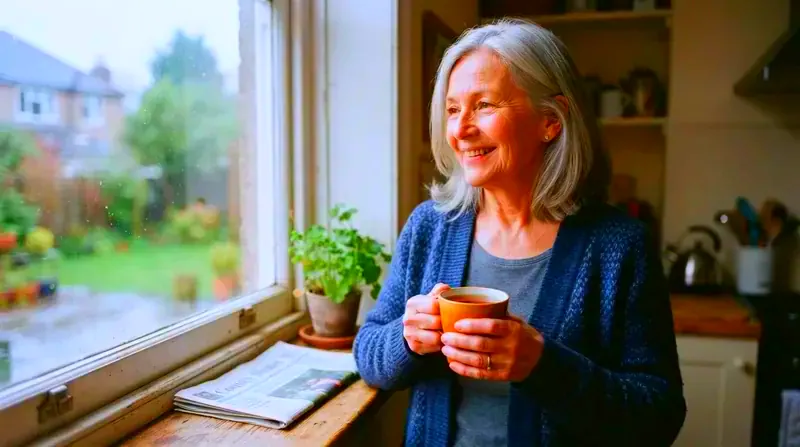
Helen, week six, which is as close as this paper gets to a victory lap, and it still isn't one.
A smile over a mug isn't a finding. It's a Tuesday that went as planned, and the county will take it.
The Second Box, Reviewed by the Household
Helen's husband, Frank, has read every draft of this column since 1991 and reviewed each with the same two words: "shorter, truer." He reviewed the box too, on the record, from his side of the kitchen.
"The first box was her experiment. The second is a household fixture, which happened faster than the drip machine did, and the drip machine had thirty years of head start."
His own review, conducted over three weeks, one shared pot of morning coffee (kept, with the clinician's blessing, "because nobody's perfect") and one shared afternoon box:
"The morning belongs to the coffee. The afternoon belongs to the tea.
"The evening belongs to whoever loses at gin. The house is quieter, the sleep is steadier, and the crossword page isn't folded into origami by six o'clock.
"That's my data."
The column's medical desk reminds the readership that a husband's data outranks a newspaper's on all household questions, and that Frank's final ruling — "reorder, and get two, the math works" — is printed here as the season's last word on logistics.
What the Ads Will Say Next Season
The ad desk, which shares a wall with this column and buys the ink, showed next season's headlines to the editor, who showed them to the reference desk, who showed them to me.
"Retired Clerk's 4 P.M. Ritual." That one's true enough; the whole ritual is a bag and a timer.
"Clinician-Approved." That one's dead on arrival, and the column killed it in the morning meeting with the sentence every honest desk keeps taped to the kettle: no clinician has approved anything on this page, and no honest page implies otherwise.
"The Tea That Fixed Her Afternoons." Half true, which is the whole problem with ad language.
The tea filled the mug; the ritual fixed the afternoons.
The ad desk is reworking it with the distinction intact, and the column will check the rework before it runs, because that's the arrangement, and the arrangement is what keeps this paper worth your morning.
The season closes with the desk's standing offer to every reader: if an ad we run ever says more than this page can support, write in, and the correction runs in the same size type as the original.
The Corrections and Caveats desk, small but undefeated, thanks you for reading the whole file, margin notes and all.
Seven named herbs · 18 organic bags · 0 mg caffeine · sold by Living Wellness Partners LLC
Letters to the Tea Desk, Vol. 2
The tea desk — a drawer in the reference desk, technically — reopens for the season's second volume.
From a retired schoolteacher, 72: "You wrote that no tea gives anyone back a name. I clipped that sentence and put it on the refrigerator, next to my mother's recipe for pie.
"Honesty like that belongs next to pie." The desk agrees and is considering the compliment the highest in its file.
From a night-shift nurse, 51: "The young techs at the hospital drink the mushroom coffees. I drink this at three a.m. because three a.m. never asked for caffeine, it asked for warmth."
The desk prints the letter whole.
From a farmer, 68: "Fence-row mullein grew back on the south forty, same as your October paper said. I don't drink tea but I read the paper for the farming."
The desk congratulates the mullein and reminds readers that the box's plants are grown, not foraged, by people with certificates.
From a grandson, 29: "I sent this column to my grandmother because she stopped drinking coffee and started being boring. She read all nine thousand words, called me, and argued about the crossword for an hour.
"Best phone call in years." The desk doesn't sell tea, prints the letter anyway, and considers the season justified.
From Howard, again: "The diner has the buttons now. I want it noted my letter retired first."
Noted. The file stands corrected.
Questions the county actually asks
No. It tastes like a polite garden — sage and mint in the front, a rosemary warmth behind, oregano as a cameo. Palates adjust in about a week.
Zero milligrams, by design. None of the seven plants in the blend carry caffeine. Morning coffee can stay. This is the afternoon cup.
The box does not say. Proprietary blend. The honest consequence: nobody can compare this cup to any trial, and anyone who does the comparison for you is making it up.
That question belongs to your clinician with the box on the table. Ginkgo in particular has a known conversation to have with anything that thins the blood.
Not on the product page. There is a 30-day returns policy to 3305 Tyler Street, Carlsbad. You pay return shipping unless the item is damaged, defective or wrong. Opened food is not returnable. We print the rule as the shop prints it.
Call your clinician — not a checkout page. Some causes are found and fixed in one appointment. That sentence outranks everything else on this page.
The desk did buy it, and the box on the kitchen shelf is half gone. Reorder status: yes, pending the last week of the month. The column will update the file either way.
The Label, Line by Line
Every line printed on the seller's "Inside Your Cup" panel, in order, exactly as the desk read it: organic ginkgo biloba leaf, organic holy basil leaf, organic sage leaf, organic spearmint leaf, organic gotu kola herb, organic oregano leaf, organic rosemary leaf.
The box prints no per-herb amounts — only the 18 bags, the caffeine-free line, and the brewing guide of 3 to 5 minutes. The full guide, with what each plant is and what the research does and does not say, lives on the ingredient page linked in the footer of this article.
The File, Closed Honestly
Every season of this column ends with the filing of one card, typed by the columnist and approved by the kitchen.
This season's card reads:
A retired clerk replaced a four o'clock coffee with 18 bags of seven named herbs. Her afternoons taste like her own.
Her sister's kettle got a job, her compost got paper, and the diner — buttons and all — has voted.
The herbs are traditional. The research is modest to empty.
The label is honest about the names and silent about the milligrams, and the company answers its phone at 2 a.m.
The price is $7.95 and the returns policy is printed, including the part that doesn't go your way. The coffee tin is in the cabinet, keeping company with the drip machine, and neither has been opened since May at four o'clock.
Whether the box belongs on your counter is a conversation between you, your clinician, and your own sense of what an afternoon should taste like.
The Ledger recommends reading the label first. Helen recommends reading everything first.
Between the two of us, the county is in good hands.
$7.95 a box, about $0.44 a cup · 5% and 10% tiers on the shop · 30-day returns
The Typesetter's Note
The last column-inch of the season traditionally goes to the typesetter, who has set this paper since before the renovation and will set it after the next one.
"This file ran nine thousand words about a tea bag," the typesetter writes, "and I set every one of them, which is more than I can say for the water-tower piece, and I'd like the record to show the tea was better copy."
"Tighter margins, cleaner breaks, and not one headline that lied. Set it again next season.
"The ink's yours."
The column accepts the compliment on behalf of the whole desk, adds a final thank-you to the readers who made it to the end, and files the season.
Thursday: the water tower. Sunday: the bake sale.
Every afternoon between: whatever's in your mug, at the hour you chose, in the chair you like. That's the whole editorial position, and it always was.
The desk light clicks off now. The season is filed, the card is shelved, and the margin note — underlined twice, in pencil, by a woman who found her afternoons at the bottom of a mug — goes with it.
Goodnight from the County Ledger, and from the whole crew of it — the reference desk, the typesetter, the tea drawer, and the woman at the kitchen table who started all of it by reading a label out loud.
The kettle knows the way from here, and so, by now, do you.
After the Ink Dries
One more column-inch, and then the desk goes dark until Thursday.
Somewhere in this county, a legal pad is filling up. Somewhere in Carlsbad, a mailer is crossing a loading dock.
Somewhere in a kitchen you know, a four o'clock cup is being poured — coffee, tea, or water, whatever the clinician and the day agreed on.
The County Ledger's only wish for that kitchen is the one the season has been building toward all along: that the afternoon belongs to whoever is living it.
Helen's margin note says hers does. The crossword says so too, six weeks running.
Frank's gin deck votes by a different margin, but that's a different season's file.
Thank you for reading the whole thing — the labels, the caveats, the opened-food line, the 2:14 a.m. call. The paper is only as honest as its longest file, and this one ran long on purpose.
The porch light stays on. The kettle cools.
The archive, the drawer, and the reference desk stand ready for Thursday, when the water tower finally gets the front page it was promised.
See you there, reader. Bring a pencil.
P.S. Forty-four cents a cup against the diner's two twenty-five, a phone that answers at 2 a.m., and a returns policy that includes the closed door — the arithmetic is on the table and the table is where it belongs. If the four o'clock has been running on autopilot, one box questions it properly.
P.P.S. Remember Helen, sixty-six, who lost a name at the glass and got a kettle, a crossword in pencil, and a sister who mails things. That's the whole wager of this page in one sentence. The box is optional. The appointment is not.
One last picture for the file, the desk's own kitchen at the hour this column gets written:

Pure Mind Blend, in one last look
Buddha Teas Pure Mind Blend — 18 organic tea bags, not a capsule, not a powder. Seven named herbs: ginkgo, holy basil, sage, spearmint, gotu kola, oregano, rosemary. 0 mg caffeine.
Bleach-free, plastic-free bags. $7.95, about $0.44 a cup.
Helen takes hers at four in the mug that used to hold coffee. Marjorie takes hers between lesson plans.
The clinician said keep doing whatever it is, which isn't an endorsement and the column won't dress it as one. Living Wellness Partners LLC, 3305 Tyler Street, Carlsbad, California. (800) 642-3754, 24/7. [email protected].
Sold by Living Wellness Partners LLC, Carlsbad CA · 18 bags · The price is set by the seller
The desk's honest summary
The seller publishes a 30-day returns policy, not a satisfaction promise. Returns go to 3305 Tyler Street, Carlsbad; you pay the shipping back unless the item is damaged, defective or wrong. Opened food is not returnable — a tea bag that has met a kettle stays yours. What the house does publish: a street address, a 24/7 phone, and seven herbs named in public.